Introduction: The Age-Old Debate
Walk into any deer camp in America, pour a cup of coffee, and ask: "What makes deer move?"
You will get a dozen different answers.
"It's the moon phase!" says the old-timer.
"It's the barometric pressure," says the weatherman.
"It's just the rut," says the optimist.
For decades, hunters have relied on superstition, anecdotes, and "gut feelings" to decide when to skip work and sit in a tree. But in the age of Artificial Intelligence and big data, we don't have to guess anymore. We can analyze.
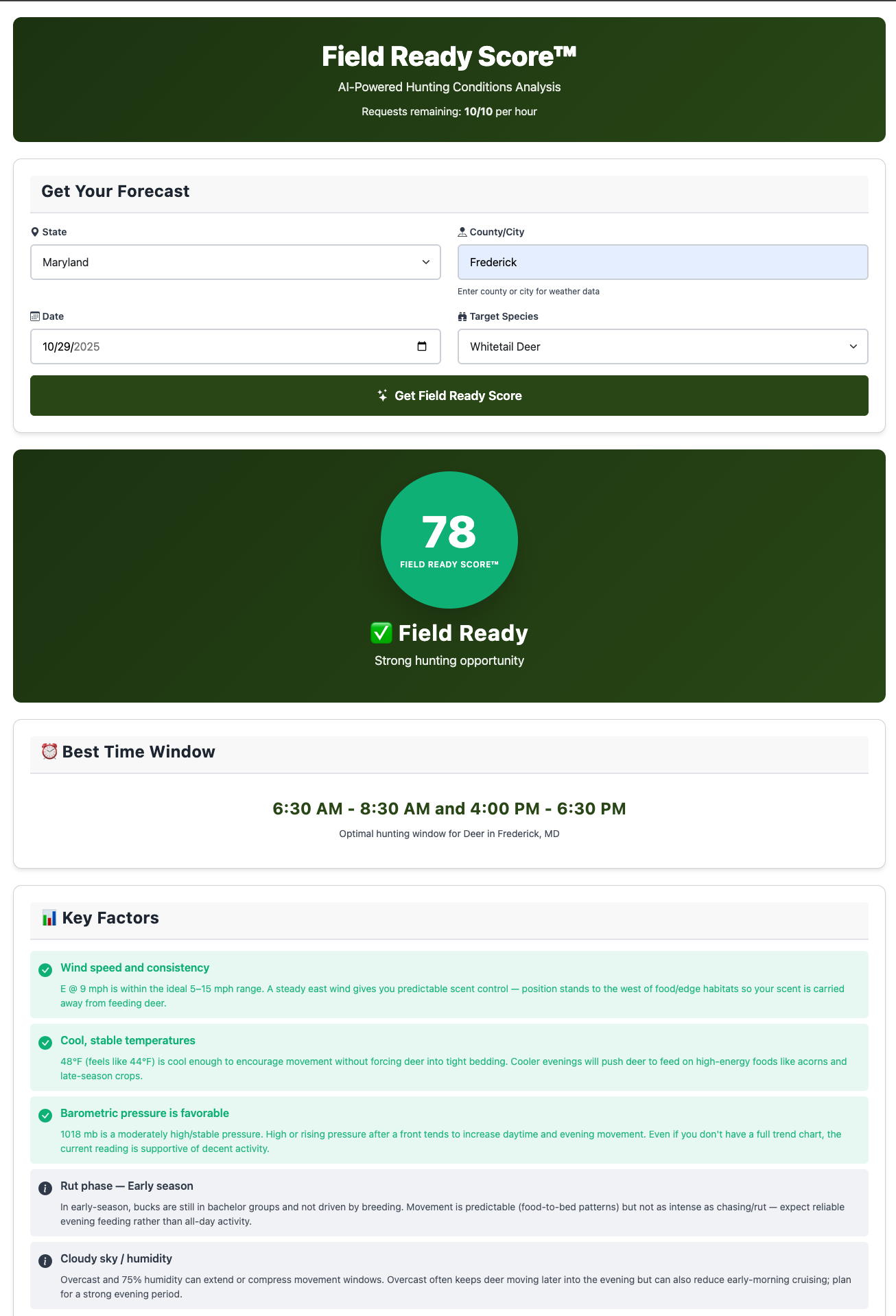
This is the deep dive into the Field Ready Score—HuntLease's proprietary AI forecasting tool. We are going to pull back the curtain and explain the science of why the score says what it says, and how you can use it to predict your best hunt of the year.
The Algorithm: Not Just a Weather App
Most "hunting forecasts" are just weather apps with a camo background. They tell you it's raining, so they give you a bad score. But biology is more complex than that.
The Field Ready Score utilizes an AI model (GPT-4o-mini) trained on decades of hunting data and biological research. It ingests complex variables—location, date, species, and live meteorological data—to output a 0-100 Success Probability Score.
Let's break down the major variables the AI weighs.
Variable 1: Barometric Pressure (The Silent Trigger)
If you take nothing else from this article, remember this: Whitetail deer are slaves to barometric pressure.
The Science
Deer detect pressure changes through their inner ear or perhaps a sensory organ we haven't fully identified yet. When pressure drops (a storm is coming), they feed heavily to stock up energy. When pressure rises rapidly (the storm is clearing), they move to dry off and feed again.
How Field Ready Scores It
- Steady Low Pressure (< 29.80): Score Penalty. Deer are often bedded, waiting out the low.
- Steady High Pressure (> 30.20): Neutral/Positive. Movement is consistent.
- Rapidly Rising Pressure: SCORE BOOSTER. This is the "sweet spot"—usually the 24 hours immediately following a cold front. The AI identifies this trend and will often flag it as "Prime Time."
Variable 2: The Cold Front Effect
Temperature isn't about the absolute number; it's about the change (Delta).
A 50°F day in August is freezing. A 50°F day in January is a heatwave. The AI looks at the temperature trend relative to the seasonal average.
- The Drop: A temperature drop of 10°F or more within 24 hours triggers a massive instinctual urge to feed in whitetails and waterfowl. This spikes your Field Ready Score.
- The Stability: Consistent weather leads to consistent (but predictable) movement.
- The Heat Wave: Temperatures 10°F+ above average will tank your score, especially during the rut. Deer have heavy winter coats; if it's hot, they move at night. The AI knows this.
Variable 3: The Rut Phase Calendar
Biology trumps weather. During the peak rut (breeding season), a buck will run through a tornado to find a doe. The Field Ready Score integrates a geo-specific rut calendar.
The rut happens at different times across the country.
Minnesota: Early November.
Alabama: Mid-January.
South Texas: December.
If you input a location in Alabama in November, the AI knows it is not the rut yet, and weighs weather heavily. If you input Minnesota in November, the AI knows it is the rut, and it will boost your score even if the weather is mediocre, because the biological drive to move is so high.
Species Specifics: One Size Does Not Fit All
A "100" score for a duck hunter is a "0" score for a turkey hunter. The Field Ready engine adapts its logic based on your target.
1. Whitetail Deer
Ideal Profile: Cold, rising pressure, light wind (5-10mph), overcast.
2. Wild Turkey
Turkeys rely entirely on eyesight and hearing to survive.
High Winds (15mph+): Score Killer. They can't hear predators, so they get nervous and shut up.
Rain: Score Killer. They stand in open fields and stop moving.
Ideal Profile: 60°F, calm winds, bluebird skies (High Pressure).
3. Waterfowl (Ducks/Geese)
Waterfowl move on "migration days" and "feeding days."
The "Bad" Weather Bonus: Strong North winds and freezing temps boost the score significantly.
Cloud Cover: Ducks don't like flying in bright sun (shadows scare them). Overcast days boost the score.
Ideal Profile: 25°F, 20mph North Wind, Overcast/Snowing.
Case Study: The "perfect" Hunt
Let's look at a real-world example of the Field Ready Score in action.
Date: November 7th
Location: Ohio
Forecast: Rain ending at 4:00 AM. Temp dropping from 55°F to 38°F. Wind NW at 10mph. Pressure rising.
Field Ready Score: 94 (Prime Time)
The AI's Logic:
1. Rut Phase: Peak Rut in Ohio (Base Score High).
2. Precipitation: Rain is ending before daylight (Positive).
3. Temp: 17° drop in temperature (Massive Positive).
4. Pressure: Rising rapidly behind the front (Massive Positive).
5. Wind: Perfect velocity for movement without suppression.
Result: This is a day you call in sick to work.
How to Use This Data
Knowledge is power, but execution is key. Here is how to use the Field Ready Score to manage your season:
- The Long-Range Plan: Check the score 5-7 days out. If you see a "Prime Time" day forming, clear your calendar.
- The Morning Check: Check the score before you drive to the lease. If it's a "Stay Home" (Score 20) due to swirling high winds, maybe you catch up on sleep and hunt the afternoon instead.
- Stand Selection: Read the "Key Factors" in the report. If the score is high because of a Cold Front, hunt a food source. If it's high because of the Rut, hunt a funnel or pinch point.
Frequently Asked Questions
Q: How accurate is the score?
A: The score is a probability forecast. It cannot guarantee a kill, but it accurately predicts movement. If the score is high, game will be on its feet. Being in the right spot is still up to you!
Q: Does it work for Elk or Bear?
A: Currently, the specialized AI models are tuned for Whitetail, Turkey, and Waterfowl. We are training models for Elk and Western Big Game for future updates.
Q: Why did I see deer on a "Low Score" day?
A: Deer have to eat every day. You can still kill deer on bad days (especially if you are near bedding), but your odds of seeing a mature buck in daylight are significantly lower.
Conclusion: Hunt Smarter
The days of guessing are over. The Field Ready Score gives you the analytical edge of a biologist and the weather-wisdom of a veteran hunter, all in your pocket.
Don't just hunt hard. Hunt at the right time.