Introduction
You've found a great hunter. They seem responsible, they respect your land, and they're willing to pay a fair price for access. You shake hands, tell them where the property lines are, and say "see you opening day."
Stop right there.
No matter how trustworthy someone seems, a handshake agreement is a recipe for problems. Without a written lease agreement, you're setting yourself up for:
- Misunderstandings about property boundaries
- Disputes over payment and access dates
- Liability exposure with no legal protection
- No recourse if rules are violated
- Awkward confrontations that could have been avoided
The good news? A comprehensive hunting lease agreement prevents all of these problems. It protects both you and your hunter, establishes clear expectations, and provides legal documentation if disputes arise.
In this guide, we'll walk you through exactly what needs to be in your hunting lease agreement, explain why each clause matters, and provide you with a free template you can download and customize for your property.
Why Every Hunting Lease Needs a Written Agreement
Before we dive into the specifics, let's establish why this matters so much.
Legal Protection
A written lease agreement:
- Establishes liability waivers that can protect you if someone is injured
- Proves the terms you both agreed to if disputes end up in court
- Demonstrates professionalism that courts favor if challenged
- Provides clear termination procedures to end bad relationships cleanly
Clear Expectations
A good lease agreement eliminates confusion by documenting:
- Exact property boundaries and access points
- What activities are allowed (and prohibited)
- Rules for guests, vehicles, stands, and equipment
- Payment terms and due dates
- Start and end dates for hunting privileges
Relationship Foundation
Perhaps most importantly, a written agreement starts your relationship on the right foot. It shows you're a professional landowner who takes this seriously, and it helps filter for hunters who are equally professional.
Responsible hunters appreciate clear agreements. They want to know the rules and expectations. If someone balks at signing a lease agreement, that's a red flag.
The Anatomy of a Hunting Lease Agreement
A comprehensive hunting lease agreement has several key components. Let's break down each section and what it should include.
Section 1: The Parties
What it is: This section identifies who is entering into the agreement.
What to include:
- Lessor (Landowner): Your full legal name and mailing address
- Lessee (Hunter): Hunter's full legal name, mailing address, phone number, and email
- Property Description: Legal description of the property (from your deed) or clear description with county, parcel number, and acreage
Why it matters: You need to clearly establish who has rights and responsibilities. If you co-own property with someone, all owners should be listed as lessors.
Example Language:
This Hunting Lease Agreement ("Agreement") is entered into on [Date] between [Your Name], located at [Your Address] ("Lessor"), and [Hunter's Name], located at [Hunter's Address] ("Lessee"), for the property described as [Property Description], containing approximately [X] acres in [County], [State].
Section 2: Lease Term and Dates
What it is: The specific dates when hunting privileges begin and end.
What to include:
- Start date: When access begins (consider pre-season scouting)
- End date: When all hunting activities must cease
- Renewal terms: Whether the lease automatically renews or requires renegotiation
- Access for off-season: Whether lessee can access property for stand placement, food plots, trail cameras, etc.
Why it matters: Without clear dates, you'll face confusion about when access starts/ends and whether the hunter can enter your property outside of hunting season.
Example Language:
This Agreement shall commence on [Start Date] and terminate on [End Date]. Lessee shall have access to the property for scouting purposes beginning [X days/weeks] prior to the start date. All tree stands, equipment, and personal property must be removed by [Date]. This lease does not automatically renew and requires written agreement from both parties to extend.
Pro Tip: Many landowners set their lease to end 1-2 weeks after the last day of hunting season. This gives hunters time to retrieve equipment but ensures they're not on the property indefinitely.
https://huntlease.co/blog/blog/maryland-hunting-leases-2025-complete-guide-to-prices-regions-laws/
Section 3: Payment Terms
What it is: How much the hunter will pay and when payment is due.
What to include:
- Total lease amount: The complete cost for the term
- Payment schedule: Lump sum, installments, or monthly payments
- Due dates: Specific dates when payments must be received
- Payment method: Check, cash, electronic transfer, etc.
- Late payment penalties: What happens if payment is late
- Refund policy: Whether payments are refundable if lease is terminated early
- Security deposit: If applicable, amount and terms for return
Why it matters: Money disputes are the #1 cause of failed hunting leases. Crystal-clear payment terms prevent this.
Example Language:
Lessee agrees to pay Lessor a total sum of $[Amount] for the hunting season. Payment shall be made in [full/installments] as follows: [Payment schedule]. All payments are non-refundable except as provided in Section [Termination]. Payments received more than [X days] after the due date shall incur a late fee of $[Amount] or [X%] of the payment due, whichever is greater. Payment shall be made by [check/cash/electronic transfer] to [Payment instructions].
Pricing Models to Consider:
- Per-acre pricing: $X per acre (e.g., $15/acre for 100 acres = $1,500)
- Per-person pricing: $X per hunter on the property
- Flat-rate exclusive: One price for exclusive access regardless of number of hunters
- Per-season pricing: Different rates for different game seasons
Use our Lease Price Calculator to determine fair market value for your property. Based on Hundreds of listings from multiple sites
Section 4: Property Description and Boundaries
What it is: Precise definition of where the hunter can and cannot go.
What to include:
- Legal description: From your property deed
- Acreage: Total acres included in the lease
- Map or plat: Attached map showing exact boundaries (THIS IS CRITICAL)
- Excluded areas: Any areas that are off-limits (around homes, barns, specific fields, etc.)
- Access routes: Designated roads, trails, or entry/exit points
- Parking locations: Where vehicles must be parked
Why it matters: Boundary disputes are the #2 cause of hunting lease failures. A clear map eliminates 90% of these problems.
Example Language:
The leased property consists of approximately [X] acres as shown on the attached map (Exhibit A), located at [Address/Description]. The leased area is bounded by [Physical descriptions - roads, creeks, fence lines, etc.]. The following areas are specifically EXCLUDED from this lease and Lessee shall not enter: [List excluded areas]. Lessee shall access the property only via [Describe access routes]. Vehicles must be parked at [Designated locations].
Critical: Always attach a physical map to your lease agreement. You can:
- Use county parcel maps
- Print satellite imagery with boundaries drawn
- Use HuntLease.co's mapping tool to draw precise boundaries
- Hire a surveyor for complex properties
Section 5: Permitted Activities and Game
What it is: What the hunter is allowed to hunt and how.
What to include:
- Species allowed: Deer, turkey, waterfowl, small game, etc.
- Weapon restrictions: Firearms, archery, muzzleloader
- Bag limits: Beyond state limits (e.g., "no more than 2 does per season")
- Hunting methods: Stand hunting, spot and stalk, baiting (where legal), dogs
- Season restrictions: Whether hunting is limited to specific state seasons or includes off-season (where legal)
Why it matters: You may want to limit harvest to manage your wildlife population, or you may have safety concerns about certain weapons near neighbors.
Example Language:
Lessee is permitted to hunt the following species during their respective legal hunting seasons: [List species]. Hunting shall be conducted using [archery/firearms/muzzleloader/all legal methods]. Lessee agrees to harvest no more than [X bucks and X does] during the lease term. [Baiting is/is not permitted] in accordance with state regulations. Use of dogs is [permitted/prohibited].
Section 6: Rules and Regulations
What it is: The specific dos and don'ts for using your property.
What to include:
Guest Policies:
- How many guests can the lessee bring?
- Must guests be supervised by the lessee?
- Do guests need to sign a separate waiver?
Tree Stand/Blind Rules:
- Can lessee install permanent stands?
- Screw-in steps allowed?
- Where can stands be placed?
- Must stands be removed at season end?
Vehicle Use:
- Are ATVs/UTVs allowed?
- Speed limits on property
- Designated trails only or open travel?
Food Plots and Habitat:
- Can lessee plant food plots?
- Who maintains plots?
- Can lessee clear shooting lanes?
Campfire/Smoking:
- Are fires allowed?
- Designated locations only?
- Smoking policies?
Trash and Conservation:
- Pack in, pack out policy
- No littering
- Respect for property and wildlife
Alcohol and Drugs:
- Zero tolerance policies
- Prohibition on hunting while impaired
Example Language:
The following rules and regulations shall govern Lessee's use of the property:
1. Guests: Lessee may bring up to [X] guests. All guests must be accompanied by Lessee at all times and are subject to all terms of this Agreement.
2. Tree Stands: Lessee may install [temporary/permanent] tree stands. Screw-in steps are [permitted/prohibited]. All stands must be [removed by end of lease term/clearly marked with Lessee's name]. Stands may not be placed within [X feet] of property boundaries or [other restrictions].
3. Vehicles: [ATV/UTV use is permitted on designated trails only/prohibited]. Speed limit on all property roads is [X mph]. No driving on wet fields or sensitive areas.
4. Food Plots: Lessee [may/may not] plant food plots with prior written approval from Lessor. Lessee is responsible for maintenance of any plots planted.
5. Alcohol/Drugs: Consumption of alcohol or illegal drugs on the property is strictly prohibited. Hunting while under the influence is grounds for immediate termination.
6. Conservation: Lessee agrees to respect the property, pack out all trash, and follow all state and federal wildlife regulations.
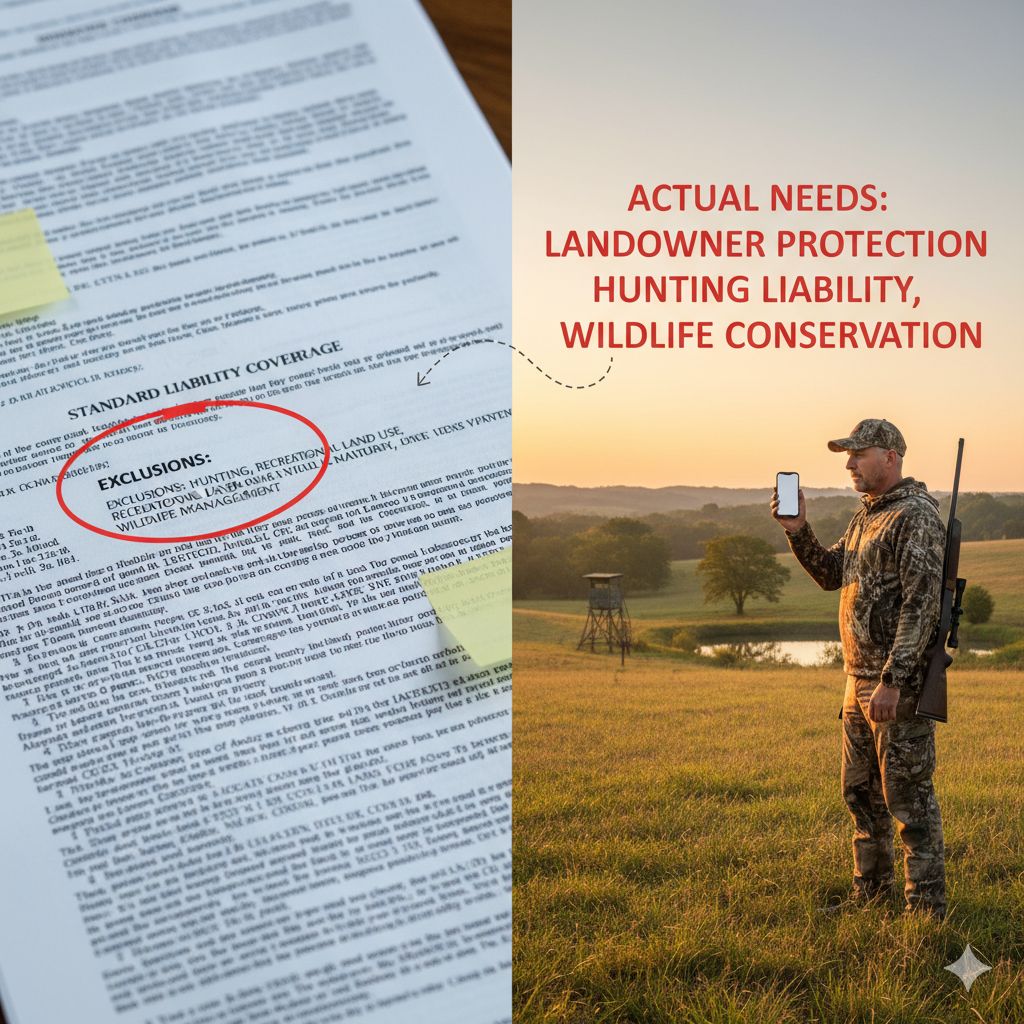
Section 7: Liability and Insurance
What it is: Who is responsible if something goes wrong, and what insurance is required.
What to include:
- Assumption of risk: Hunter acknowledges hunting is dangerous and assumes all risks
- Liability waiver: Hunter waives right to sue landowner for injuries
- Indemnification: Hunter agrees to reimburse landowner for costs if landowner is sued
- Insurance requirements: Minimum coverage amounts hunter must carry
- Additional insured: Requirement that landowner be named as additional insured
- Proof of insurance: When certificate must be provided
Why it matters: This is your primary legal protection. Without these clauses, your lease provides minimal protection.
Example Language:
Lessee acknowledges that hunting is an inherently dangerous activity and voluntarily assumes all risks of injury, death, or property damage arising from use of the property. Lessee agrees to release, waive, discharge, and covenant not to sue Lessor for any claims arising from Lessee's use of the property.
Lessee agrees to indemnify, defend, and hold harmless Lessor from any and all claims, demands, causes of action, damages, or expenses (including attorney's fees) arising from Lessee's use of the property or actions of Lessee's guests.
Lessee shall maintain comprehensive general liability insurance with minimum limits of $[Amount] per occurrence and shall provide Lessor with a Certificate of Insurance naming Lessor as Additional Insured. Certificate must be provided before hunting privileges begin and renewed annually.
Understanding Hunting Lease Liability - Complete Protection Guide
Hunting Lease Insurance: What You Need to Know
Section 8: Landowner Rights and Access
What it is: Your rights to access and use your own property during the lease term.
What to include:
- Landowner access: Your right to enter the property at any time
- Land management activities: Your ability to farm, log, conduct maintenance, etc.
- Other lessees: Your right to lease to others (if not an exclusive lease)
- Showing property: Your right to show property to potential buyers or future lessees
Why it matters: Just because you've leased hunting rights doesn't mean you've given up access to your own property. Make this explicit.
Example Language:
Lessor reserves the right to access the property at any time for any purpose including but not limited to: property maintenance, agricultural operations, timber management, inspection, and showing the property to others. Lessor makes no guarantee of exclusive hunting rights and may lease hunting privileges to additional parties [or, for exclusive leases: "This is an exclusive hunting lease and Lessor agrees not to lease to other hunters during the term"].
Section 9: Termination and Default
What it is: How and when the agreement can be ended, and what happens if someone violates the terms.
What to include:
- Termination for cause: Conditions allowing either party to end the lease early
- Notice requirements: How much advance notice is required
- Violations: What happens if rules are broken
- Cure period: Time to fix violations before termination
- Property retrieval: Timeline for removing stands/equipment after termination
- Refund policy: Whether payments are refunded for early termination
Why it matters: You need a clean exit strategy if the relationship doesn't work out.
Example Language:
Either party may terminate this Agreement with [X days] written notice to the other party. Lessor may immediately terminate this Agreement without notice if Lessee: (a) fails to make required payments; (b) violates any rules or terms of this Agreement; (c) damages property; (d) hunts while intoxicated; (e) allows unauthorized persons to hunt; or (f) engages in illegal activities on the property.
Upon termination for cause by Lessor, Lessee forfeits all lease payments and must immediately remove all equipment and property. Lessee shall have [X days] to retrieve tree stands and personal property. Items not removed will be considered abandoned.
If Lessor terminates without cause, Lessee shall be refunded a pro-rata portion of payments for unused hunting days. If Lessee terminates without cause, no refund shall be provided.
Section 10: General Provisions
What it is: Standard legal language that makes the agreement enforceable.
What to include:
- Entire agreement: This document contains all terms (no verbal agreements)
- Amendments: Changes must be in writing and signed by both parties
- Severability: If one clause is invalid, the rest remains in effect
- Governing law: Which state's laws apply
- Assignment: Whether lessee can transfer rights to someone else (usually prohibited)
- Dispute resolution: How disputes will be handled (mediation, arbitration, or courts)
Example Language:
This Agreement constitutes the entire agreement between the parties and supersedes all prior negotiations and agreements. No modification shall be valid unless in writing and signed by both parties. This Agreement shall be governed by the laws of [State]. Lessee may not assign or transfer rights under this Agreement without written consent from Lessor. In the event of dispute, parties agree to first attempt mediation before pursuing legal action.
Section 11: Signatures and Date
What it is: Where both parties sign and date the agreement.
What to include:
- Signature lines for lessor and lessee
- Printed names
- Date of signature
- Witness signatures (optional but recommended)
Example Language:
By signing below, both parties acknowledge they have read, understand, and agree to all terms of this Hunting Lease Agreement.
LESSOR: Signature: _________________ Date: _______ Printed Name: _________________
LESSEE: Signature: _________________ Date: _______ Printed Name: _________________ Phone: _________________ Email: _________________
Pro Tip: Have each party initial every page of the agreement. This prevents someone from claiming they didn't see a particular page or that pages were added after signing.
Per-Person vs. Exclusive Leases: Key Differences
Your lease agreement will look different depending on whether you're leasing to multiple individual hunters or giving one person/group exclusive access.
Per-Person (Non-Exclusive) Leases
Structure:
- You lease to multiple individual hunters
- Each hunter pays for their own access
- Hunters may encounter each other on the property
Lease Considerations:
- Need clear rules about how many total hunters you'll allow
- Should specify quiet hours, weekday vs. weekend access
- May want to assign different sections of property to different hunters
- Need coordination system if multiple hunters want to hunt same areas
Example: You own 200 acres and lease to 5 different hunters at $400 each = $2,000 total income
Exclusive Leases
Structure:
- One person or group has sole hunting rights
- They can bring guests (within limits you set)
- They don't have to share with anyone else
Lease Considerations:
- Typically command higher prices
- Need clear limits on number of guests
- Lessee manages their own group and guests
- Simpler for you to manage (one relationship instead of multiple)
Example: You lease the same 200 acres exclusively to one person/group for $2,500
Which is Better?
- Per-person: More total income potential, but more management work
- Exclusive: Premium pricing, simpler management, attracts more serious hunters
Special Clauses You Might Need
Depending on your property and situation, you may want to include additional clauses:
Wildlife Management Clause
If you have specific management goals:
Lessee agrees to support Lessor's wildlife management goals by: [list specific practices like reporting harvests, selective doe harvest, participating in surveys, etc.]. Lessee agrees to report all harvests to Lessor within 24 hours.
Trail Camera Policy
To prevent disputes about cameras:
Lessee may install trail cameras for scouting purposes. Cameras must be clearly marked with Lessee's name and contact information. Cameras must not be placed [near other hunters' stands/near home/etc.]. Lessor is not responsible for stolen or damaged cameras.
Timber/Habitat Alteration
If you want to control what changes hunters can make:
Lessee may not cut, damage, or remove any trees, vegetation, or natural features without prior written approval from Lessor. Shooting lane clearing is limited to [brush and vegetation under X inches diameter/must be pre-approved/etc.].
Emergency Contact and Permission
For safety and access:
In case of emergency, Lessee should contact: [Your contact info]. If Lessee cannot reach Lessor, Lessee is authorized to take reasonable emergency actions including [contacting emergency services, providing property access to first responders, etc.].
Climate/Weather Restrictions
To protect land during vulnerable times:
Lessee agrees not to access the property with vehicles when ground conditions are wet or muddy to prevent damage to roads and fields. Lessor reserves the right to temporarily restrict access during extreme weather conditions.
Common Mistakes to Avoid
Even with a good template, landowners often make these errors:
❌ Being Too Vague
Don't say: "Lessee can hunt the property" Do say: "Lessee can hunt the property shown in Exhibit A, excluding the area within 200 yards of the residence"
❌ Forgetting Insurance
Always include specific insurance requirements and collect certificates before allowing access.
❌ No Map Attached
A written description isn't enough. Attach a physical map showing boundaries.
❌ Weak Termination Clauses
Make sure you can end the lease if major rules are violated. Don't lock yourself into a bad situation.
❌ Verbal Side Agreements
Everything must be in writing. If you agree to something verbally later, create a written amendment.
❌ One-Size-Fits-All Approach
Customize your agreement for each property and situation. A 40-acre property in Maryland needs different terms than 500 acres in Montana.
❌ Not Keeping Copies
Always keep signed originals in a safe place. Digital copies are great, but have physical backups too.
Download Your Free Hunting Lease Agreement Template
Ready to create your own professional hunting lease agreement? We've created a comprehensive, customizable template that includes all 10 essential sections plus optional clauses you can add as needed.
What's Included:
✅ Complete agreement template in Word format (fully editable) ✅ Step-by-step instructions for customizing each section ✅ Sample language for common scenarios ✅ Checklist to ensure you haven't missed anything ✅ Map attachment template ✅ Certificate of Insurance tracking form
[MAJOR CTA: Large button for "Download Free Hunting Lease Agreement Template"]
[LINK OPPORTUNITY: Email signup to deliver the template - this is your lead magnet]
After downloading, here's what to do:
- Review the entire template before customizing
- Fill in your specific property information (parties, dates, payment, etc.)
- Customize rules to match your property and preferences
- Attach a property map showing clear boundaries
- Have it reviewed by a local attorney (optional but recommended for your first lease)
- Sign with your hunter and keep copies for both parties
When to Get an Attorney Involved
Consider legal review if:
✅ Your property has complex ownership (partnerships, LLCs, family trusts) ✅ You're leasing high-value property or charging premium prices ✅ You have unique liability concerns (adjacent to public lands, near developments, etc.) ✅ Your state has unusual recreational use or liability laws ✅ You're providing lodging, guides, or services beyond simple land access ✅ You want to add very specific clauses tailored to unusual situations
The cost: Most attorneys will review and customize a lease agreement for $200-$500. For your first lease or a complex situation, this is money well spent.
What to bring to your attorney:
- Our template as a starting point
- Your property deed and description
- Any specific concerns or unique circumstances
- Details about what you want to allow/prohibit
Conclusion: Your Lease Agreement is Your Foundation
A comprehensive hunting lease agreement is not just a legal document—it's the foundation of a successful, profitable, and stress-free hunting lease operation.
With clear written terms:
- You're protected from liability and disputes
- Hunters know exactly what's expected and what they're paying for
- Conflicts are prevented before they start
- Your property is respected and rules are followed
- You can confidently grow your leasing operation
The best landowners treat their hunting leases like a business, not a hobby. That starts with professional documentation.
Don't wait until there's a problem to wish you had a proper agreement. Take 30 minutes now to download our template, customize it for your property, and set yourself up for success.
Your land is valuable. Your time is valuable. Protect both with a rock-solid hunting lease agreement.
Get Your Free Lease Agreement Template Now
Frequently Asked Questions
Q: Is a hunting lease agreement legally binding without notarization?
A: Yes. In most states, lease agreements do not require notarization to be legally binding. However, both parties must sign it, and both should keep copies. Notarization adds an extra layer of validity but is usually not necessary for hunting leases.
Q: Can I use the same lease agreement for all my hunters?
A: Yes, you can use the same template, but you should customize details for each hunter (names, dates, payment amounts, specific areas if you're dividing property, etc.). The general rules and terms can stay consistent.
Q: What if my state doesn't have clear laws about hunting leases?
A: Your lease agreement is still enforceable under basic contract law. The agreement creates a "license" for the hunter to access your property. Consult with a local attorney if you have specific concerns about your state's laws.
Q: How long should my lease term be?
A: Most hunting leases run for one season (3-6 months). Some landowners prefer year-round leases if they have multiple hunting seasons (deer, turkey, waterfowl). Shorter initial terms let you evaluate the relationship before committing long-term.
Q: What if a hunter violates the lease agreement?
A: Follow your termination clause. Typically, you provide written notice of the violation and give them a short time to correct it (cure period). If they don't fix the issue or commit a serious violation, you can terminate immediately and require them to remove equipment and leave the property.
Q: Do I need separate agreements for each guest a hunter brings?
A: Not necessarily. Your agreement with the primary lessee should specify guest rules and state that guests are subject to the same terms. However, it's smart to require the primary lessee to have guests sign a separate liability waiver acknowledging the rules and assuming risk.
Q: Can I change the terms mid-season?
A: Major changes require mutual agreement and should be documented with a written amendment signed by both parties. Minor clarifications or new rules can be added with written notice, but significant changes to payment, boundaries, or core terms need consent from both parties.
Disclaimer: This article provides general information and a template for hunting lease agreements. It should not be considered legal advice. Laws vary by state and situation. For your specific circumstances, consult with a licensed attorney familiar with property law and recreational use statutes in your jurisdiction. The template provided is a starting point and should be customized and reviewed by legal counsel before use.