The Best Trail Cameras and Cellular Scouting Tech for 2026
Disclosure: As an Amazon Associate, Huntlease earns a commission from qualifying purchases made through the links on this page. This helps support our platform at no additional cost to you.
Whether you are a hunter looking to pattern that big buck you spotted in velvet, or a landowner trying to keep unwanted visitors off your property, a reliable trail camera is essential. But with the plethora of options on the market, how do you know which ones are worth your hard-earned money and which will break after the first rainstorm?
We have compiled this massive guide on the best trail cameras of 2026, along with a few must-have accessories you need to pick up before the season starts.
We might be biased, but our absolute first recommendation before you even buy a piece of hardware is the Huntlease app. For a $10 subscription, it is the best way to get a lay of the land and secure exclusive access to landowner contact information so you can legally place these cameras in the first place. The app's new scouting feature also allows you to drop digital pins marking exactly where you placed each trail camera on the topographic map. This ensures you never lose a camera in the timber and allows you to seamlessly track buck movement patterns across the entire property. Check out this article for more information about all the features.
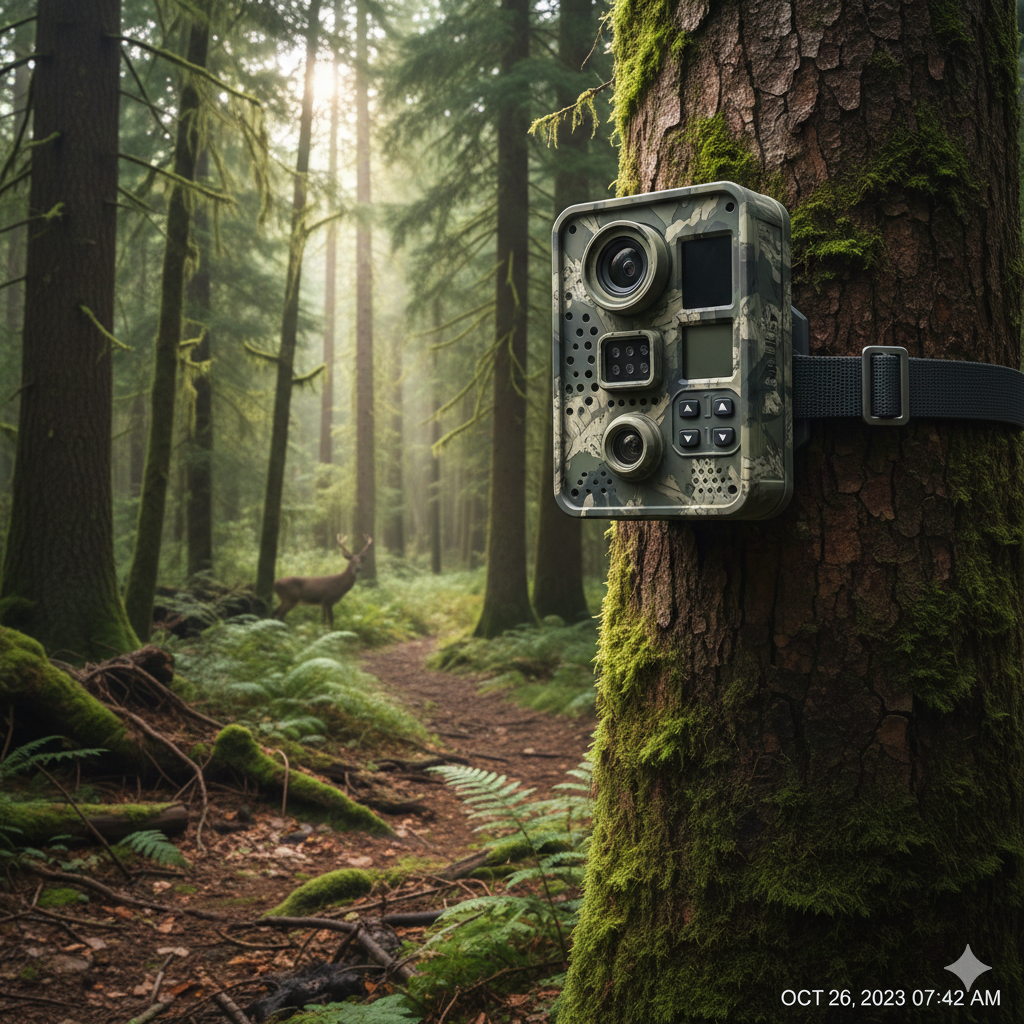
What to Look for in a Modern Trail Camera
Before diving into the top picks, here is a quick breakdown of the specifications that actually matter in the woods. Do not get tricked by marketing jargon; here is what separates a great camera from a frustrating one:
- Trigger Speed & Recovery Time: Trigger speed is the time it takes for the camera to wake up and take a photo once it senses motion. Anything under 0.5 seconds is ideal for catching a rutting buck moving fast on a trail. Recovery time is how quickly the camera can save that photo and prepare to take another one.
- Flash Type: "Low-Glow" (Red Glow) flashes emit a faint red light when triggered, which provides a significantly better nighttime illumination range. "No-Glow" (Black Flash) is completely invisible to deer and trespassers, making it the top choice for security and for mature bucks that might be easily spooked, though the nighttime range is slightly shorter.
- Cellular vs. SD: Cellular cameras send photos directly to your phone via an app and a data plan, saving you from walking into the woods, laying down ground scent, and spooking deer. Traditional SD cameras require you to pull the card manually but save you from paying monthly subscription fees.
- Megapixels (Image Quality): High megapixels mean you can zoom in closely on a photo on your phone to count tines or identify a specific drop-tine buck. Keep in mind that many cameras use "interpolated" megapixels (software-enhanced), but the top tier still delivers incredible HD clarity.
The Top Trail Cameras of 2026: Deep Dive Reviews
Best Overall Trail Cam: Tactacam Reveal Ultra
The Reveal Ultra takes the top spot for 2026 by packing premium, high-end features into a highly reliable, sub-$200 package. Tactacam listened to hunters and built a camera that solves almost every backcountry problem. It features a built-in GPS that works even if the camera is powered off (a massive theft deterrent) and offers on-demand live video streaming so you can check a field edge in real-time.
One of its best features is the switchable flash. You can toggle between a low-glow flash (reaching up to 96 feet) for open areas, or a no-glow flash (80 feet) when you have it tucked tight on a scrape in the timber.
- Pros: Switchable low/no-glow flash, active GPS tracking, live video streaming, incredibly easy-to-use app, and a 2-inch LCD screen for easy field setup.
- Cons: Requires 12 AA batteries (which can get expensive), and the SD card slot is located awkwardly on the inside of the door.
- [Check Price on Amazon]
Best Value Trail Cam: SpyPoint Flex G-36
If you want top-tier performance without emptying your wallet, the SpyPoint Flex G-36 is the undisputed value king of the woods. Retailing right around the $100 mark, it triggers consistently at impressive distances up to 110 feet, day and night.
With a massive 36-megapixel resolution and a highly responsive, automated app, it delivers the performance of cellular cameras that cost twice as much. SpyPoint's antenna technology is also fantastic at grabbing a signal in those deep, hollowed-out ravines where cell service is notoriously spotty.
- Pros: Incredible price point, massive 110-foot detection range, 36MP photo resolution, and dual-SIM technology that automatically connects to the strongest cellular network available.
- Cons: Trigger speed is slightly slower than the premium models, and SpyPoint's data plans can be rigid depending on how many photos you expect to receive.
- [Check Price on Amazon]
Best Budget Trail Cam: SEHMUA 4G LTE Cellular
For hunters or landowners looking to cover multiple trails, property lines, or gates on a strict budget, the SEHMUA gets the job done. It is not a legacy hunting brand, but it offers essential cellular connectivity and solar compatibility right out of the box.
This makes it a highly affordable entry point for remote scouting and basic security without a massive upfront investment. If you need to buy five cameras to blanket a new lease, this won't break the bank.
- Pros: Extremely budget-friendly, includes a solar panel to extend battery life, and provides reliable basic cellular alerts.
- Cons: Image quality is noticeably lower than the Tactacam or Browning, and the accompanying app lacks the polished hunting-specific features of the major brands.
- [Check Price on Amazon]
Best Streaming Camera: Spartan Camera GoLive 2
When you need to see what is happening right now, the Spartan GoLive 2 is unparalleled. It is built for the hardcore scout and the serious property manager. It offers nearly instantaneous live-streaming video capabilities at up to 30 frames per second with minimal delay.
It also features a massive 96-degree wide-angle lens, making it the perfect camera to monitor a massive agricultural field or a wide-open food plot. It comes with an internal 5300 mAh rechargeable lithium battery, making it incredibly easy to hook up directly to a solar panel.
- Pros: Unmatched live-streaming quality, ultra-wide 96-degree field of view, internal rechargeable battery, and tamper-resistant GPS.
- Cons: It is an expensive investment, and the physical camera housing is a bit bulkier than competitors.
- [Check Price on Amazon]
How to Choose a Cellular Data Plan
Buying the camera is only half the equation; you have to power the transmission. Every major brand (Tactacam, SpyPoint, Browning) requires you to use their specific app and data plans. You cannot just swap your personal cell phone SIM card into them.
- Free/Low-Tier Plans: Brands like SpyPoint offer a free tier (usually around 100 photos a month). This is great for a security camera on a gate that rarely triggers, but it is useless over a corn feeder where you will burn through 100 photos in a single day.
- Mid-Tier Plans ($5 - $10/month): Usually nets you 250 to 1,000 photos. This is the sweet spot for a camera placed on a scrape or a tight pinch point in the timber where deer only pass through occasionally.
- Unlimited Plans ($15+/month): If you are putting a camera on a highly active food plot, a mineral site, or an area with a lot of non-target wildlife (raccoons, squirrels), you need an unlimited plan to avoid overage charges.
Pro Tip: Look for brands that offer "Shared Plans" if you run multiple cameras. This allows you to pool your photo limits across three or four cameras, saving you money if one camera goes quiet while another blows up.
Trail Camera Placement Strategies
Even the best camera in the world is useless if you point it at an empty tree. Whether you are hunting the rolling hardwood ridges of Pennsylvania or the thick, dense timber and agricultural edges of Maryland, strategic placement is everything.
- The Field Edge (Early Season): Place your wide-angle cameras (like the Spartan GoLive 2) facing out into cut corn or bean fields in September. Mount them slightly higher (around 6 feet) and angle them down to get a broader view of where bachelor groups are entering the field.
- Scrapes and Rub Lines (Pre-Rut): As October rolls in, move your cameras into the timber. Find primary scrape areas. Mount the camera about knee-to-waist high, roughly 15 feet away from the scrape. Use a "No-Glow" camera here so the flash doesn't spook mature, nocturnal bucks checking the scent.
- Pinch Points and Funnels (The Rut): During the rut, bucks are cruising. Find a terrain feature that forces deer into a tight bottleneck—like a fence line gap, a steep creek crossing, or a strip of timber between two open fields. Set the camera to "Burst Mode" (taking 3 photos in rapid succession) because rutting bucks rarely stop to pose.
- Map It All: Every time you hang a camera, immediately open your Huntlease app and drop a trail camera pin. When you start getting photos of a target buck on Camera A on Tuesday, and Camera B on Thursday, you can visually connect the dots on the topographic map to figure out his travel corridor.
Must-Have Trail Camera Accessories
Do not let cheap batteries or a stolen camera ruin your season. Add these essentials to your loadout to maximize your camera's performance.
Energizer Ultimate Lithium AA Batteries Never use cheap alkaline batteries in a cellular camera. Alkaline batteries lose voltage as they drain, which causes the cellular antenna to fail before the camera actually dies. Lithium batteries maintain a consistent voltage until they are completely dead, perform flawlessly in freezing late-season temperatures, and will literally double or triple the lifespan of your camera in the woods.
SanDisk Extreme Pro 32GB SD Cards A camera is only as good as the card saving the photos. Cheap SD cards corrupt easily in the heat and cold. The SanDisk Extreme Pro offers the fast write speeds required to capture 4K video and rapid-fire burst photos without skipping a beat. (Always buy 32GB or less; many trail cameras cannot read 64GB+ cards).
Master Lock Python Adjustable Cable Lock Public land and high-traffic leases require security. The Master Lock Python cable threads perfectly through the back bracket of almost every modern trail camera. It cinches tight around the tree, making it nearly impossible for a casual thief to walk away with your $200 investment.
Stealth Cam Touchscreen SD Card Reader If you still run traditional non-cellular cameras to save on data plans, this is a game-changer. Plug your SD card straight into this handheld 4.3-inch touchscreen to swipe through photos and delete the false triggers right from the tree stand. It completely eliminates the need to lug a bulky laptop into the woods or swap cards back and forth.
HME T-Post Camera Mount Trees are never exactly where you need them to be. If you are hunting a clearcut, a swamp edge, or a vast ag field, this heavy-duty steel mount slides directly over a standard metal farm T-post. It allows you to place your camera at the perfect height and angle literally anywhere on the property.
Frequently Asked Questions (FAQ)
Do trail camera flashes spook mature bucks? It depends on the deer and the flash. White flashes (like an old digital camera) absolutely spook deer. Low-glow (red flash) is usually tolerated by young bucks and does, but a highly pressured, mature whitetail will often notice the red LED and avoid the area. If you are targeting a specific, mature buck in tight timber, always opt for a No-Glow (Black Flash) camera.
How high should I mount my trail camera? The standard rule of thumb is waist-to-chest high (about 3 to 4 feet off the ground), keeping it parallel to the ground. However, if you are hunting public land or an area prone to theft, mount the camera 7 to 8 feet up the tree and use a stick behind the top of the camera housing to angle it downward. This keeps it out of a human's direct line of sight while still capturing the trail.
Why is my cellular camera taking photos of nothing? "False triggers" are usually caused by the sun or the wind. Trail cameras use Passive Infrared (PIR) sensors that trigger when they detect a change in heat and motion. If a branch is blowing in the wind and the sun is beating down on it, the camera reads that as a moving heat signature. Clear all brush and high grass within 15 feet of the front of your camera to stop burning through your data plan.
Dial In Your Scouting, Then Find Your Land
Upgrading your trail camera arsenal gives you the ultimate advantage in the woods. It saves you time, keeps human scent out of the timber, and gives you a 24/7 look at exactly what is walking your property.
But having the best cellular tech in the world doesn't matter if you don't have exclusive ground to hunt. Stop wasting the summer knocking on doors and getting turned away. Head over to the right now to subscribe. You will get instant, direct access to landowner contact information so you can negotiate your lease, lock down your property, and get those cameras hung well before opening day.